Gratitude Journaling: How to Start and Why It Works

Gratitude journaling has a reputation problem. It sounds like something you do when everything is fine and you want to feel even better. Like luxury wellness. Like a practice for people who already have their lives together.
That is not what the research says. Gratitude journaling works best when things are hard. When your default mental state is scanning for problems, writing down what is actually going well forces a recalibration. Not toxic positivity. Just balance.
What the science actually shows
Researchers at UC Davis ran a study where participants wrote down five things they were grateful for once a week for ten weeks. Compared to the control group, the gratitude group exercised more, reported fewer physical symptoms, and felt better about their lives overall.
Other studies have linked consistent gratitude practice to better sleep, lower stress hormones, and stronger relationships. The mechanism is straightforward: what you pay attention to grows. Directing attention toward what is working does not ignore what is not. It just stops the negative from being the only signal.
Why most people quit gratitude journaling
They start with a list. "I am grateful for my health. My family. My home." And after a week it feels like copying the same words every day. The practice dies because it stopped making them think.
The fix is specificity. Not "I am grateful for my partner" but "I am grateful that my partner made coffee this morning without me asking, because it meant I got five extra minutes." The detail is where the feeling lives.
A better approach: three levels of gratitude
Instead of listing random things, try moving through three layers each session:
- Something small from today. A good meal. A song that hit right. Sunshine through the window at the right moment. Things you normally overlook.
- Something about your life right now. A relationship, a skill you have built, a problem you solved this month. Things that are easy to take for granted because they are stable.
- Something difficult that taught you something. A failure that redirected you. A hard conversation that cleared the air. This is where gratitude journaling stops being shallow and starts changing your relationship with struggle.
Three entries. Five minutes. That is enough to shift the lens.
When to write
Most people do better with evening gratitude. The day has happened. You have material to work with. Writing in the morning often defaults to abstract statements because nothing specific has occurred yet.
That said, morning gratitude works well if you focus on layer two: things about your life that are already true. It sets an intentional tone for the day instead of diving straight into tasks and obligations.
Pick one time. Protect it for a week. That is long enough to notice whether it changes anything.
The blank page problem
Some days you will sit down and genuinely struggle to find something. That is not a failure. That is information. It usually means you are either exhausted or operating on autopilot, moving through days without registering them.
On those days, go smaller. The texture of your sheets. The fact that you have clean water. The dog who was happy to see you. Start with the obvious and let the pen find its way to something real.
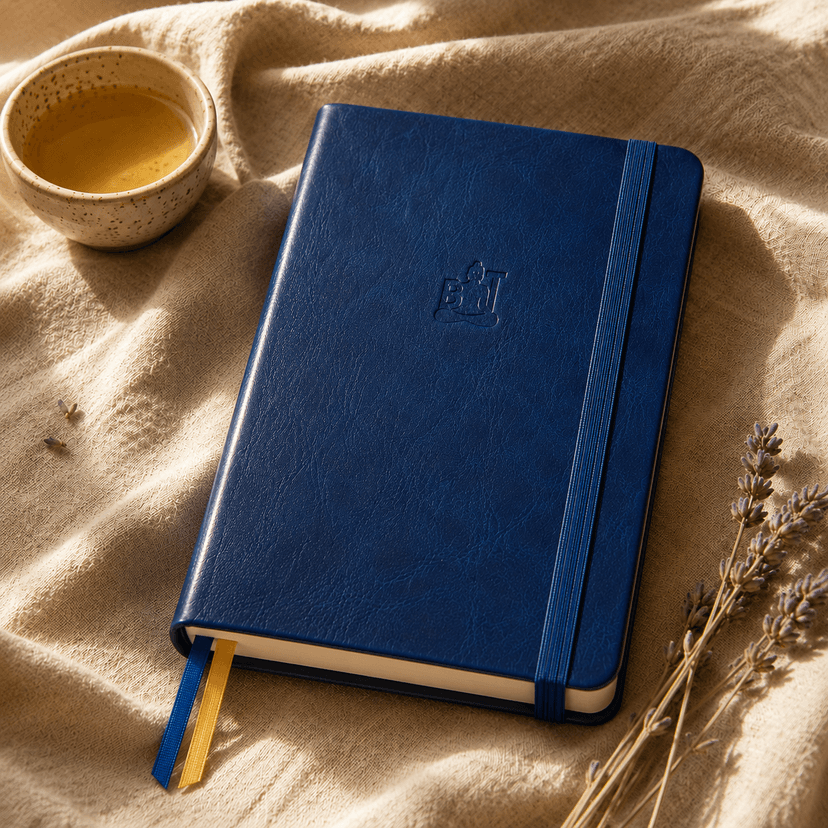
A journal with guided prompts helps here. The Mindful Journal includes 50 prompts designed for exactly these moments when you know you want to write but cannot find the thread. You do not use them every day. But on the days you need them, they are the difference between writing and not writing.
Gratitude is not about performing happiness. It is about noticing what is already there. And writing it down makes it real in a way that thinking it never does.
Ready to start your practice?
The Mindful Journal gives you 224 pages, 50 guided prompts, and 120 GSM paper that makes every session feel intentional.
View the Journal