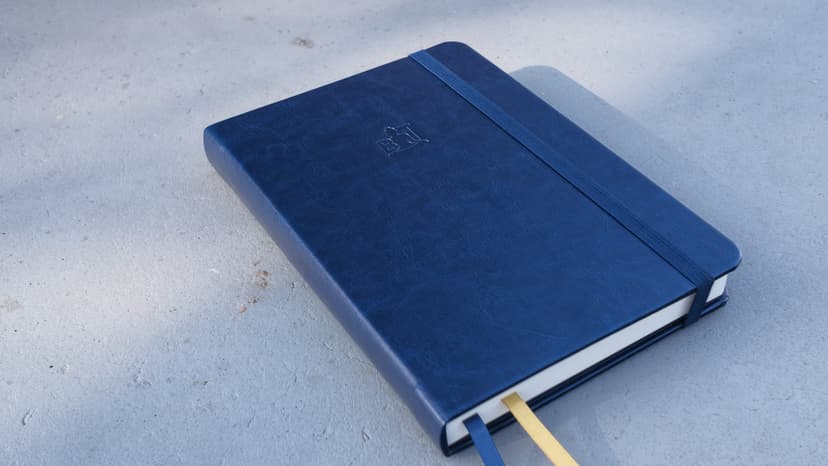
Why Writing by Hand Still Wins

You can type 60 words a minute. You can write maybe 15 by hand. On paper, typing should win every time.
But speed is not the point. The slowness of handwriting is not a bug. It is the entire mechanism.
Your brain processes differently when you write by hand
Researchers at Princeton and UCLA found that students who took notes by hand performed significantly better on conceptual questions than those who typed. The reason is not about the notes themselves. It is about what happens during the act of writing.
When you type, you can transcribe almost verbatim. Your fingers move fast enough that the words pass through you without processing. When you write by hand, you have to slow down, filter, and decide what matters enough to commit to the page. That forced processing is where understanding happens.
The same principle applies to journaling. Typing out your thoughts can feel productive, but handwriting forces you to sit with them. The pace matches the speed of genuine reflection rather than the speed of your fingers.
Digital devices split your attention
Open your laptop to journal and you are one tab away from email, one notification away from a text, one habit loop away from checking something that does not matter. The device does not want you to focus. It is engineered to pull you elsewhere.
A journal has no notifications. No algorithm. No other function. When you open it, the only thing you can do is write or think. That constraint is a feature.
People who switch from digital journaling to handwriting consistently report that their entries become deeper and more honest. Not because paper is magical. Because paper does not interrupt.
The physical experience changes the emotional one
There is a tactile dimension to handwriting that screens cannot replicate. The weight of the pen. The texture of the paper. The sound of writing. These sensory inputs ground you in the present moment in a way that is hard to explain until you experience the difference.
This is particularly true for journaling around difficult emotions. Typing about anxiety can feel like documenting it. Writing about anxiety by hand can feel like releasing it. The physical act of moving the pen creates a sense of externalizing what is internal.
Paper does not judge your output
When you write on a screen, there is an implicit audience. Even in a private document, the text looks finished. It looks like it should be coherent and polished. That pressure shapes what you write, usually toward what sounds good rather than what is true.
Handwriting is inherently imperfect. Crossed-out words, messy margins, sentences that trail off. That imperfection gives you permission to be honest. You are not publishing. You are thinking on paper.
You remember more of what you write by hand
The motor memory involved in handwriting creates stronger neural pathways than typing. When you write something by hand, you are more likely to remember it days later without rereading it. The physical act encodes the content differently in your brain.
For journaling, this means the insights you capture do not just live on the page. They live in you. The intention you set this morning stays with you through the afternoon. The realization you wrote down last night surfaces when you need it.
How to make the switch
If you have been journaling digitally, switching to paper might feel slow at first. That friction is temporary. Give it a week and the slowness starts to feel deliberate rather than limiting.
Start with five minutes. One page. Do not worry about filling it. The point is not volume. The point is presence.
The right journal makes this easier. Paper that feels smooth under the pen. A binding that stays open without fighting you. Pages thick enough that nothing bleeds through. These details sound minor until you are writing every day and they become the difference between a practice that sticks and one that fades.
Your phone will always be faster. But faster is not the goal. The goal is honest, focused reflection. And for that, pen and paper still wins.
Ready to start your practice?
The Mindful Journal gives you 224 pages, 50 guided prompts, and 120 GSM paper that makes every session feel intentional.
View the Journal