Journaling vs. Therapy: What Writing Can and Cannot Do

There is a version of wellness culture that treats journaling as a substitute for therapy. Write it out. Process it on the page. You do not need to talk to anyone.
That version is incomplete. But so is the clinical counterargument that writing is just a coping strategy with limited depth. The honest answer is more specific than either side admits.
What journaling can actually do
The research on expressive writing is legitimate. James Pennebaker's work at the University of Texas showed that people who wrote about difficult experiences for 15 to 20 minutes over several days showed measurable improvements in immune function, fewer doctor visits, and lower levels of distress. The effect was not enormous, but it was consistent and replicated.
More recent research has refined this. Journaling works best for:
- Reducing rumination by externalizing and organizing thought loops
- Building emotional vocabulary, which reduces the intensity of difficult emotions
- Increasing clarity on values, priorities, and patterns
- Providing a processing space between therapy sessions
- Tracking changes in mood and thought patterns over time
These are real benefits. For many people managing stress, anxiety, life transitions, and the ordinary difficulty of being a person, journaling provides something valuable that nothing else does as efficiently.
What journaling cannot do
It cannot diagnose. It cannot provide the specific relational context of therapeutic work. It cannot catch the patterns in your thinking that you are too close to see yourself. It cannot hold you accountable in the way another person can. And for conditions like major depressive disorder, OCD, trauma-related disorders, and others, it is not a treatment. It is at best a complement to one.
There is also a failure mode where journaling reinforces negative patterns instead of interrupting them. Writing the same anxious thoughts in circles, without any structure or redirection, does not reduce the anxiety. It rehearses it. Unstructured venting without any reflective component is not the same thing as productive journaling, and confusing the two can make someone feel worse after writing than before.
The combination that actually works
For most people not dealing with clinical-level challenges, journaling functions well as a standalone practice. You process, you notice patterns, you think more clearly.
For people in therapy, journaling extends the work between sessions. Insights that surface in therapy are easy to lose by the time the next appointment comes around. Writing them down when they are fresh preserves them. Tracking your thoughts between sessions gives your therapist a fuller picture of what is actually happening day to day, not just what you remember to mention in an hour-long appointment.
For people considering therapy but not yet there, journaling often surfaces the specific thing they need to address, which makes therapy more efficient when they start.
A note on what kind of journaling works better
Free writing and expressive writing both have solid research behind them. But for people dealing with anxiety or intrusive thinking, completely unstructured writing can make things worse. Having a prompt or a framework to move through changes the dynamic.
The research supports moving through a sequence: name the feeling, describe the situation, look for the underlying concern, identify what is in your control. You do not need a therapist to follow that framework. You need a starting point and the practice of actually sitting with it.
The honest version
Journaling is not therapy. Therapy is not optional for everyone who has it available. Both of those things are true at the same time.
What journaling gives you that therapy does not is daily access and private space. Your therapist sees you weekly or biweekly. Your journal is available at 11pm when you cannot sleep, at 6am before the day starts, in the middle of a week when something shifted and you cannot quite place what.
That accessibility is not a substitute for professional support. But it is a different kind of resource, and for a lot of people it is the thing that makes the work sustainable.
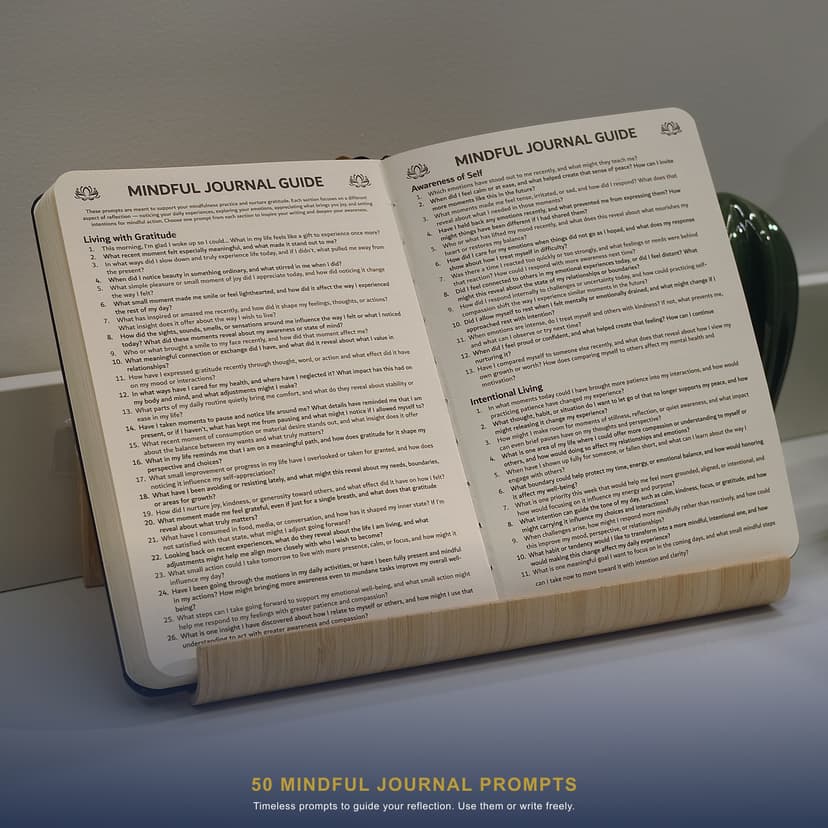
The Mindful Journal includes 50 guided prompts designed to move you through reflection rather than around it. Structured enough to keep the writing purposeful, open enough to meet you wherever you actually are. It is not a replacement for anything. It is a practice worth having alongside everything else.
Ready to start your practice?
The Mindful Journal gives you 224 pages, 50 guided prompts, and 120 GSM paper that makes every session feel intentional.
View the Journal