How to Choose a Journal: The 5 Things That Actually Matter
If you have ever bought a journal, used it for two weeks, and then quietly let it sit on a shelf, the journal was probably the problem. Not the habit. Not your discipline. The journal.
A bad tool makes the practice harder than it needs to be. A good one gets out of the way and lets you write. Here are the five things that actually separate a journal you use from one you do not.
1. Paper weight
This is the thing nobody thinks about until they are looking at ink bleeding through to the page behind. Most mass-market journals use 80 to 90 GSM paper. It is thin enough to ghost badly with gel pens and bleed through entirely with fountain pens.
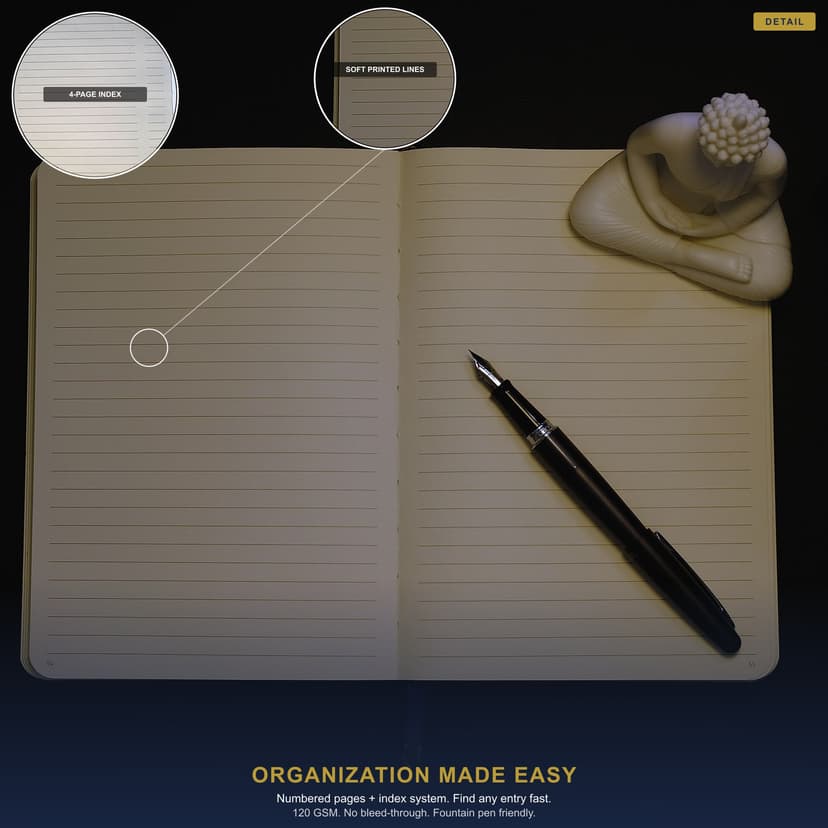
Paper rated at 100 GSM or above handles almost any writing instrument without issues. At 120 GSM, the paper has genuine thickness and texture. Ink sits on the surface cleanly. There is no bleed-through. There is no feathering.
If you write with a gel pen, a rollerball, or a fountain pen, paper weight is the most important spec on the page. Check it before you buy.
2. Binding type
There are two binding methods that matter for daily journaling: perfect binding and sewn binding.
Perfect binding is glue. It is the most common method because it is cheap. The pages hold initially, but the spine resists opening and eventually cracks. Within a few months of regular use, pages start loosening.
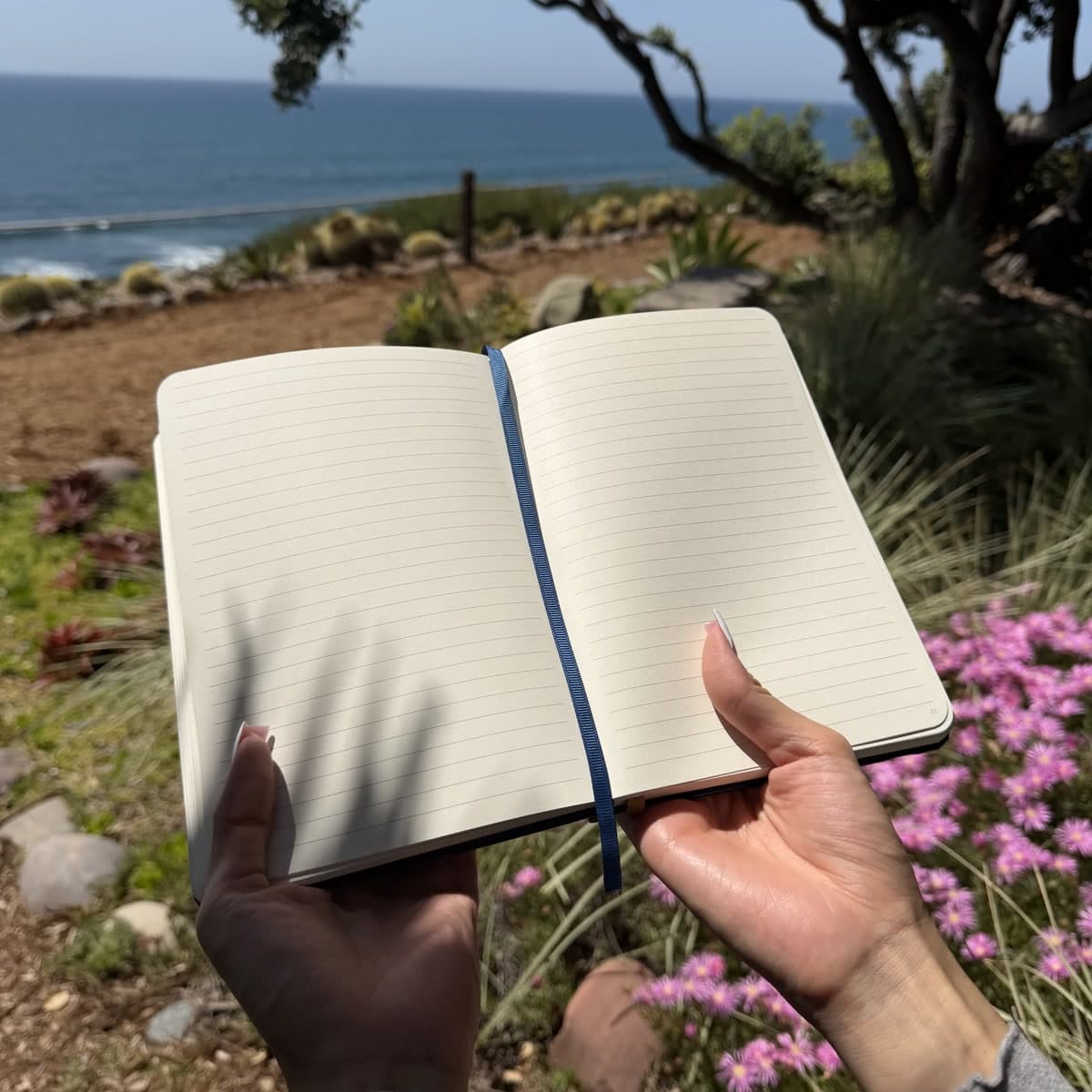
Smyth sewn binding uses thread to connect signatures of pages. The book opens completely flat and stays there. It does not resist you. It does not crack at the spine. It holds its shape for years of daily use.
If a journal does not specify the binding type, assume it is glued. If it says "lay-flat," ask how. Thread-sewn lay-flat is worth it. Glue with a flexible cover is better than nothing but not the same thing.
3. Size
A5 is the standard for daily journaling. It is roughly half of a standard sheet of paper. Large enough to write comfortably, small enough to use on a nightstand, in a bag, at a desk. You are not hunched over a notebook, and you are not trying to fill a page that feels like a parking lot.
A4 and larger formats work for people who write in bulk or sketch alongside their words. Pocket-size formats work for quick capture but are limiting for longer reflection.
If you do not have a specific reason to go bigger or smaller, A5 is the right size for a daily practice.
4. Prompts versus blank
Neither is universally better. It depends on where you are in the practice.
Blank journals work well for experienced journalers who have internalized a process. They come to the page knowing what they want to explore, and open space serves that.
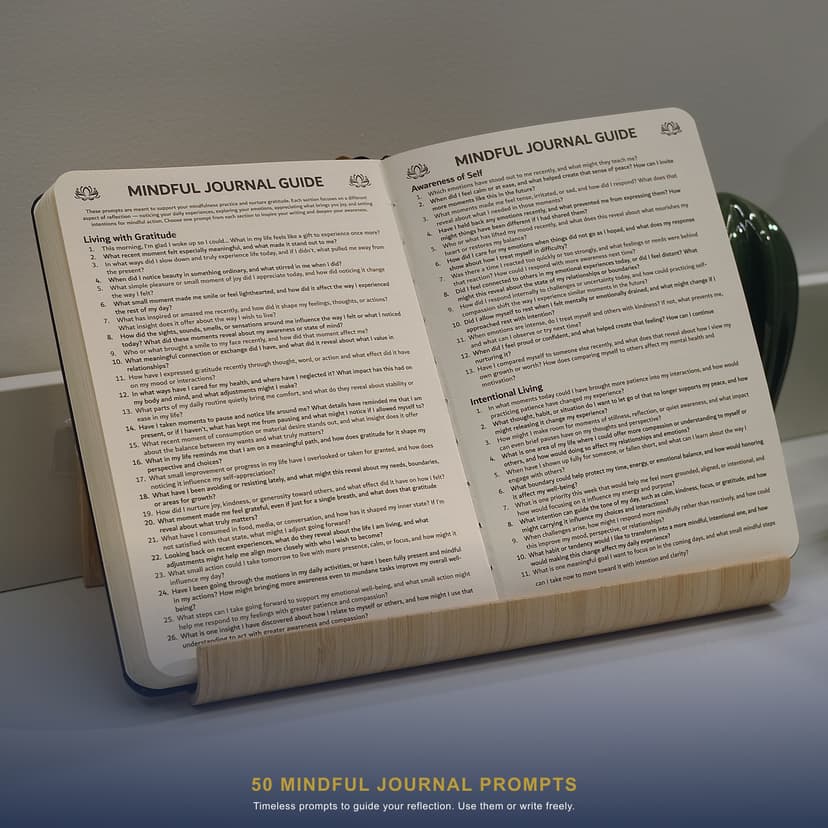
Prompted journals work better for most people who are building a habit, returning after a break, or writing during difficult stretches. A prompt gives you a starting point. It removes one decision from a moment that already requires energy.
The best setup for most people is a journal that has prompts available but does not force them. You use the prompt when you need it and ignore it when you do not. That flexibility is worth looking for.
5. Whether it feels like something worth using
This is harder to quantify but easier to notice. A journal that feels cheap, that has a flimsy cover, that makes a hollow sound when you set it down, subtly communicates that what you are doing is not worth much.
A journal with a solid cover, quality paper, and a finished feel communicates the opposite. The act of opening it has a small amount of weight to it. That matters more than it sounds, especially in the early days of building a habit when the motivation is still fragile.
You do not need to spend a lot of money to get a quality journal. But you do need to spend more than you would on a notebook from a drugstore. The difference in experience is not subtle.
What this looks like in practice
The checklist for a journal worth buying:
- Paper weight of 100 GSM or above, ideally 120 GSM if you use gel or fountain pens
- Smyth-sewn lay-flat binding, not glued
- A5 size for daily writing
- Prompts available but not mandatory
- A cover and build quality that matches what you are using it for
The Mindful Journal by Buddha Therapy meets all five. 120 GSM acid-free paper, Smyth-sewn lay-flat binding, A5 size, 50 guided prompts spread across 224 numbered pages, deep navy vegan leather with gold foil. It was built with this exact checklist in mind, because a journal that actually holds the practice is worth building correctly.
Ready to start your practice?
The Mindful Journal gives you 224 pages, 50 guided prompts, and 120 GSM paper that makes every session feel intentional.
View the Journal